Plastic Pipe Locators
Advanced Plastic Pipe Locators: Precision Equipment for Accurate Detection
Eastcom Associates, a trusted dealer and distributor, offers an essential selection of plastic pipe locators and accessories, designed for professionals who prioritize accuracy and efficiency in their utility detection tasks. As a leading company in the industry, we understand the unique challenges of locating non-metallic pipes and have curated a range of equipment, available through our dealership and distribution network, that stands up to those demands. Our professional-grade locators are known for their reliability and ease of use, making them an ideal choice for a variety of applications. With competitive pricing and a commitment to quality, Eastcom's tools for sale are the go-to solution for specialists seeking to enhance their locating capabilities. Discover how our locators can streamline your operations and ensure precision in every project.
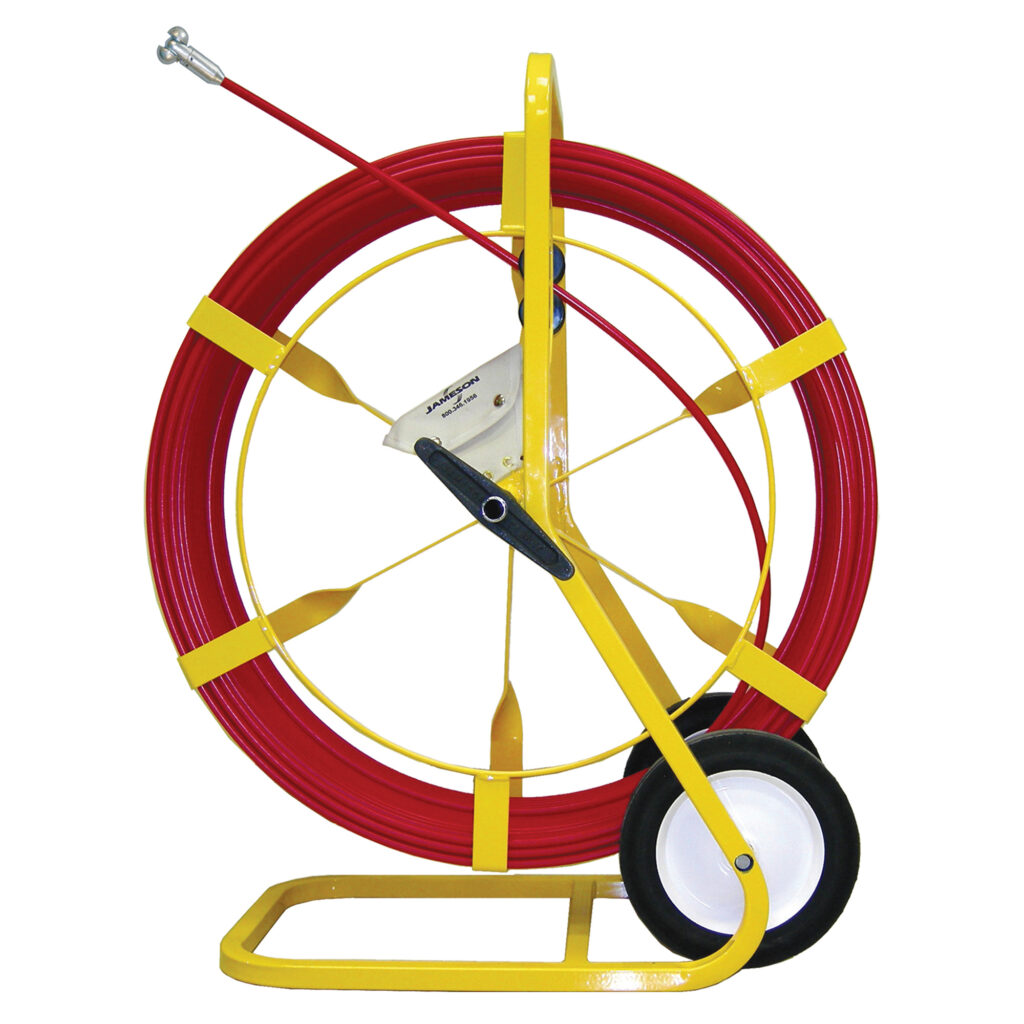
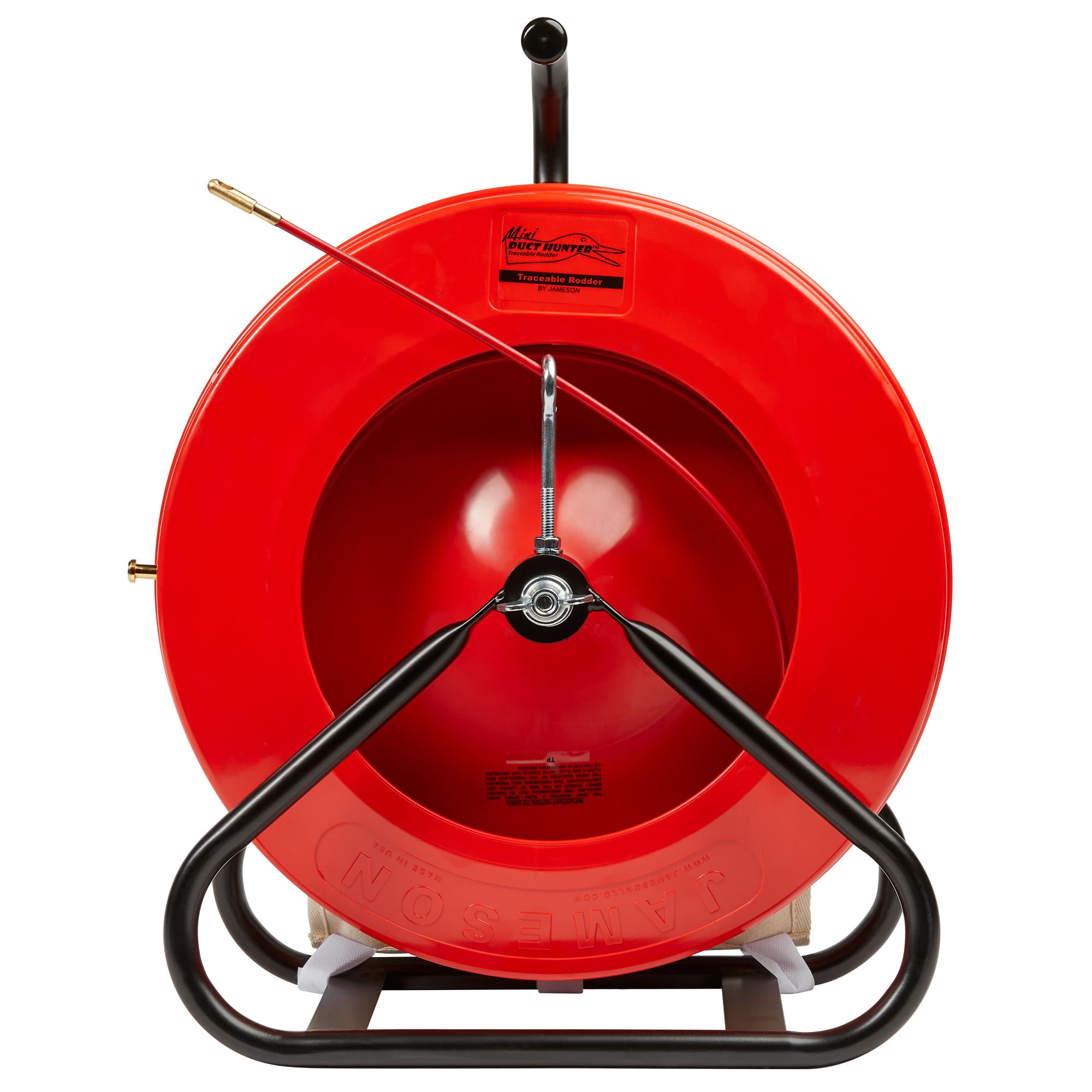
Mini Duct Hunter Traceable Rodder


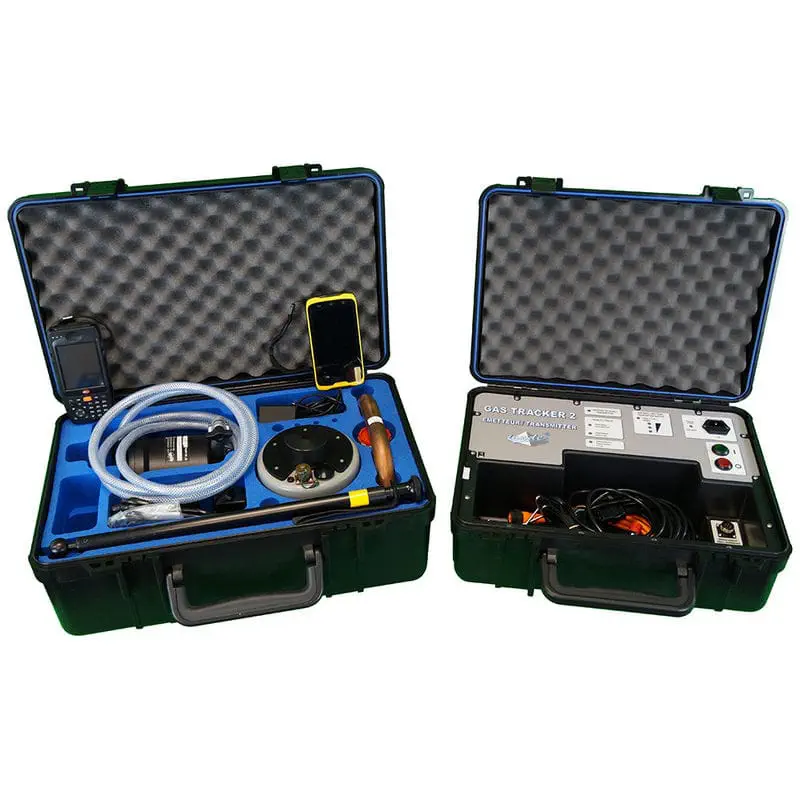
.jpeg)
Plastic Pipe Locators & PVC Pipe Detection: Technical Guide
Supporting Utility Locators in Accurately Tracing Non-Metallic Water & Gas Lines
At Eastcom Associates, we help utility professionals locate buried PVC, PE, HDPE, and other non-metallic utilities when EM locators and tracer wires fall short. Our acoustic plastic pipe - deliver reliable, non-invasive detection for water, gas, and irrigation lines—helping your crews work safer, faster, and with confidence.
Locating plastic and other non-metallic utilities has become one of the most important—and most challenging—tasks for today’s locating professionals. Unlike metallic lines, PVC, PE, HDPE, and poly service lines do not naturally conduct an electromagnetic signal, which means most traditional EM locators simply can’t detect them. As more municipalities transition to plastic water and gas infrastructure, accurate location methods are essential for reducing strikes, preventing cross-bores, and keeping excavation crews safe.
This guide explains why plastic utilities are difficult to locate, how modern acoustic plastic pipe locators solve the problem, and how to choose the right device for your job.
We Solved It - Why Plastic Pipe Location Is Challenging
Electromagnetic Locators Don’t Work on Non-Metallic Utilities
Standard EM locators require a conductive path to transmit a signal through the line. PVC, PE, and other plastics are insulators, so they:
- Do not carry current
- Do not retransmit EM signals
- Do not provide detectable electromagnetic fields
In practice, that means even the best EM transmitter can “light up” steel or copper but will pass right by a buried PVC service without any response. This creates blind spots in areas where older plastic services were installed without tracer wire.
This means a traditional locator—even with a powerful transmitter—will show no response unless a tracer wire is installed. Many older or privately installed service lines were placed without tracer wire, leaving them invisible to EM tools. As systems age and records become incomplete, this limitation becomes an increasingly serious safety and damage-prevention issue.
Ground Penetrating Radar Is Helpful, but Not Perfect
GPR can detect depth changes and anomalies, but:
- Soil moisture and mineralization can obscure signals
- PVC may not create a strong enough reflection
- Crews require additional training to interpret data
Even in ideal conditions, GPR often functions best as a confirmation tool rather than a primary plastic service locator. It can add valuable context, but doesn’t always provide the clear, continuous route tracing that field crews need.
This is why many teams use acoustic plastic pipe locators to complement GPR or replace slow, uncertain methods. By combining technologies, utilities can fill in the “blind spots” and gain a more complete picture of what’s underground.
How Acoustic Plastic Pipe Locators Work
Acoustic detection offers a fast, non-invasive way to locate buried plastic pipes—no tracer wire and no excavation required. Instead of relying on conductivity, it relies on controlled sound energy traveling through the pipe wall and the surrounding soil.
Step 1: Generate Vibrations
A small acoustic actuator introduces controlled sound waves (low-frequency vibrations) into the pipe. These vibrations travel along the line for long distances, following the same route as the buried service.
Step 2: Detect Sound at the Surface
A handheld acoustic receiver scans the ground above the pipe path. As sound energy radiates upward, the receiver senses:
- Amplitude changes
- Resonance patterns
- Directional variations
These subtle differences help the operator “follow the sound” along the buried route, even when the pipe itself can’t be detected electromagnetically.
These measurements allow the operator to trace the route of the pipe, estimate position, and confirm lateral connections. With a bit of practice, most EM locator users find the workflow familiar and easy to adopt.
Advantages of Acoustic Detection
Compared to purely visual or EM-based methods, acoustic location gives crews a practical, field-proven option for plastic services:
- Works on all types of plastic (PVC, PE, HDPE)
- No need for tracer wires or access to both pipe ends
- Fast learning curve—similar motions as using an EM locator
- Ideal for water and gas service lines
Because it is non-invasive and repeatable, acoustic locating can quickly become a standard part of pre-excavation workflows wherever non-metallic lines are present.
Frequently Asked Questions: Plastic Pipe Location & PVC Pipe Detection
What is a plastic pipe locator?
A plastic pipe locator is a specialized device designed to locate non-metallic utilities such as PVC, PE, and HDPE pipes. Most modern plastic pipe locators use acoustic technology, sending sound vibrations through the pipe and detecting those vibrations at the surface to trace the pipe’s route.
Why is plastic pipe locating more difficult than locating metallic utilities?
Plastic pipes such as PVC, PE, and HDPE do not conduct electricity, which means they cannot carry or re-radiate electromagnetic (EM) signals. Traditional EM locators rely on conductivity to detect buried utilities, so non-metallic lines often remain invisible unless a tracer wire is present. As more water and gas systems transition to plastic, this limitation has made plastic pipe detection a growing challenge for locating professionals.
Can electromagnetic locators find PVC or plastic pipes?
No—standard electromagnetic locators cannot directly detect plastic pipes. EM locators only work if a tracer wire, metallic tape, or conductive element is installed alongside the pipe. When tracer wire is missing, broken, or was never installed (common with older services), EM locators provide little to no usable signal.
How does acoustic PVC pipe detection work?
Acoustic plastic pipe locators work by introducing controlled sound or vibration into a plastic pipe using an acoustic actuator. These vibrations travel along the pipe and radiate upward through the surrounding soil. A surface receiver detects changes in sound intensity and direction, allowing the operator to follow the pipe’s path without digging or tracer wire.
When should I use a plastic pipe locator instead of GPR or EM locating?
You should consider using a plastic pipe locator when:
- The utility is PVC, PE, or HDPE
- Tracer wire is missing or unreliable
- You need to confirm the route of a service lateral
- GPR results are unclear or inconsistent
- You want a faster, more intuitive locating method
Acoustic locating is especially effective for water and gas service lines in residential and municipal environments.
Want To Know More?
➡ Contact Eastcom today to find the right plastic pipe locator or PVC pipe detector for your next project. Contact Eastcom Associates - Get Locating Solutions Now
Detailed Product Information
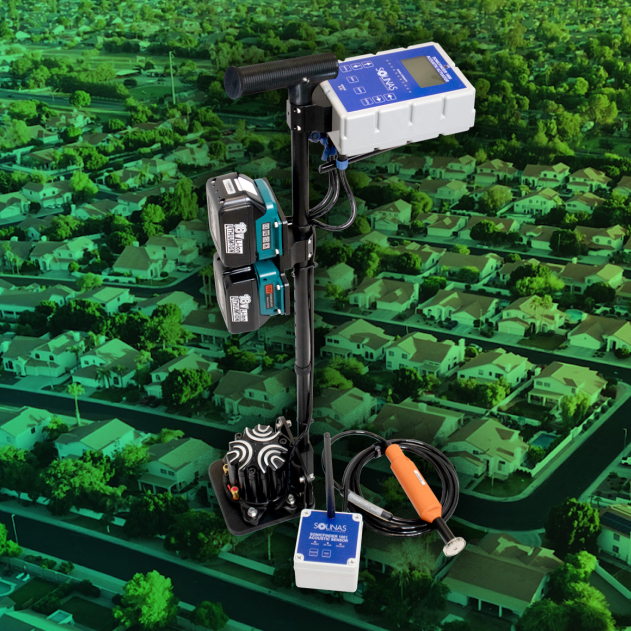
Solinas SonicFinder 1000 – Acoustic PVC Pipe Locator https://www.eastcomassoc.com/product/solinas-sonicfinder-1000
A highly accurate PVC pipe detector designed for municipalities, utility contractors, and locating professionals. The SonicFinder 1000 gives crews a dependable way to trace plastic services without relying on as-built records or guesswork.
Key Benefits:
- Intentionally engineered: Helps you find water and gas utilities easily
- Simple to use: If you can locate with a traditional EMC locator, you can use the SonifFinder1000
- Efficient technology: Uses audio sound (sonic) frequencies to locate plastic pipes
- An affordable solution: Designed to enhance the capabilities of common Ground Penetrating Radar (GPR) and EMC locators.
Key Features:
The SonicFinder 1000 includes a purpose-built acoustic actuator and sensitive surface receiver designed specifically for buried plastic utilities.
- Detects PVC, PE, HDPE, and non-metallic pipes
- Acoustic vibration-based locating
- Intuitive handheld receiver
- Fast line tracing with high positional confidence
- Compact, rugged design for field conditions
These features are engineered to help operators move quickly from setup to confirmed pipe routes with minimal training.
Technical Specifications:
Behind the simple user interface, the SonicFinder 1000 is tuned for real-world soil conditions and typical utility depths.
- Frequency range: Low-frequency acoustic band optimized for buried utility response
- Receiver sensitivity: High-gain surface pickup
- Typical detection range: Varies by pipe diameter, depth, and material
- Power: Long-life battery for full-day use
- Applications: Water service lines, gas laterals, irrigation pipes, conduit
These specs ensure that the system can handle a wide range of field environments—from residential neighborhoods to busy municipal corridors.
Key Limitations:
While the SonicFinder 1000 is a highly effective acoustic PVC pipe locator, its performance depends on site conditions and proper use.
- Acoustic locating requires the ability to introduce vibration into the pipe; access points such as meters, valves, hydrants, or cleanouts are typically required.
- Detection range and clarity can vary based on pipe depth, diameter, material, soil composition, and surrounding noise.
- Very deep utilities, heavily compacted soils, or highly attenuating ground conditions may reduce signal strength.
- Acoustic methods are optimized for route tracing rather than precise depth measurement.
For best results, the SonicFinder 1000 is often used alongside EM locators or GPR to confirm depth, crossings, or transitions between metallic and non-metallic utilities.
Duct Hunter Traceable Rodders https://www.eastcomassoc.com/product/duct-hunter
Mechanical Line Tracing for Conduit, Duct, and Non-Metallic Pathways
The Duct Hunter Traceable Rodder is a proven mechanical solution for tracing non-metallic conduit, ducts, and pathways when acoustic or EM-only methods are not ideal. By physically inserting a traceable fiberglass rod into the duct or pipe, operators can follow the rod’s path from the surface using a standard electromagnetic locator.
This approach is especially effective for short-to-medium runs, direct access points, and applications where acoustic energy cannot be efficiently introduced into the line.
Key Benefits:
- Direct physical access to the line for reliable tracing
- Works with standard EM locators and transmitters
- Ideal for plastic conduit, telecom ducts, and service laterals
- No reliance on tracer wire installation
Key Features:
- High-strength fiberglass rod designed for pushing through ducts
- Integrated traceable element for EM signal coupling
- Rugged frame and reel for controlled deployment
- Available in multiple rod lengths for varying applications
These features allow crews to establish a clear, continuous trace where non-metallic utilities would otherwise remain invisible.
Technical Specifications:
- Rod material: Fiberglass composite
- Detection method: EM signal induced on rod
- Compatibility: Standard EM locators
- Typical use depth: Depends on rod placement and soil conditions
- Applications: Conduit, duct banks, telecom pathways, non-metallic utilities
Best Use Scenarios:
- Locating plastic conduit with accessible entry points
- Verifying duct routing before excavation or HDD
- Situations where acoustic locating is impractical
Key Limitations:
The Duct Hunter Traceable Rodder provides reliable mechanical tracing, but it is not suited for every locating scenario.
- Physical access to the duct or conduit is required in order to insert the rod.
- Rod travel distance is limited by conduit condition, bends, blockages, or collapses.
- The traced path represents the rod’s position, not necessarily the exact pipe wall location in oversized or damaged conduits.
- Best suited for short-to-medium distance runs rather than long continuous utility networks.
Because this is a mechanical tracing method, it is typically used when access points are available and when acoustic locating is impractical or ineffective.
Mini Duct Hunter Traceable Rodder https://www.eastcomassoc.com/product/mini-duct-hunter-traceable-rodder
Compact Mechanical Tracing for Tight Access and Short Runs
The Mini Duct Hunter Traceable Rodder delivers the same mechanical tracing capability as full-size rodders, but in a compact form factor optimized for confined spaces and shorter utility runs. It is designed for technicians who need portability without sacrificing trace reliability.
This tool is well-suited for urban environments, pedestal access points, handholes, and service entrances.
Key Benefits:
- Lightweight and highly portable
- Faster setup in tight or congested areas
- Compatible with existing EM locating equipment
- Ideal for service laterals and short conduit runs
Key Features:
- Compact reel with traceable fiberglass rod
- Smooth rod feed and retrieval
- High-visibility housing for field use
- Simple transmitter connection
Technical Specifications:
- Rod type: Traceable fiberglass
- Detection method: EM signal coupling
- Typical application length: Short-to-medium runs
- Compatibility: Standard EM locators and transmitters
Best Use Scenarios:
- Service laterals and entry conduits
- Congested utility corridors
- Locations with limited setup space
Key Limitations:
The Mini Duct Hunter offers portability and convenience, but its compact size comes with tradeoffs.
- Shorter rod length limits its effectiveness on long conduit or duct runs.
- Less pushing force compared to full-size rodders may reduce performance in tight bends or partially obstructed ducts.
- Requires physical access to the conduit or service entrance.
- Designed for routing confirmation rather than deep or long-distance locating.
This tool is best used for service laterals, urban access points, and confined spaces where full-size rodders are impractical.
Gas Line Tracer Kit https://www.eastcomassoc.com/product/gas-line-tracer-kit
Tracer Wire Installation & Recovery for Plastic Gas Lines
The Gas Line Tracer Kit provides a practical solution for locating plastic gas lines by introducing or restoring a conductive tracer wire path. When acoustic locating is not appropriate or long-term traceability is required, tracer wire remains one of the most reliable locating methods for plastic gas infrastructure.
This kit is designed for gas utilities, contractors, and maintenance crews working with PE and plastic gas lines.
Key Benefits:
- Enables EM locating of plastic gas lines
- Long-term solution for future locates
- Works with standard EM locating equipment
- Supports regulatory compliance and damage prevention
Key Features:
- Purpose-built rodder for tracer wire placement
- Durable reel and frame for field deployment
- Designed for gas service environments
- Compatible with common tracer wire materials
Technical Specifications:
- Detection method: EM via tracer wire
- Typical application: Plastic gas mains and services
- Compatibility: EM locators and transmitters
- Installation method: Mechanical rod insertion
Best Use Scenarios:
- New gas service installations
- Retrofitting missing or damaged tracer wire
- Long-term utility mapping programs
Key Limitations:
Tracer wire remains a reliable locating method, but installation-based systems have inherent constraints.
- Requires physical installation or retrofitting of tracer wire into the gas line.
- Not a rapid locate solution for emergency or same-day locating without access.
- Installation quality directly affects long-term signal reliability.
- Not effective where access to the pipe interior is restricted or unsafe.
This kit is best suited for planned installations, infrastructure upgrades, and long-term asset management rather than immediate locate needs.
Water Line Tracer Kit https://www.eastcomassoc.com/product/water-line-tracer-kit
EM-Based Tracing for Plastic Water Services
The Water Line Tracer Kit enables accurate locating of non-metallic water lines by installing or accessing tracer wire along the pipe route. This method provides a clear, repeatable signal path for EM locators—especially valuable where acoustic locating is limited by depth, fittings, or access constraints.
It is widely used by municipal water departments and contractors managing plastic service infrastructure.
Key Benefits:
- Reliable EM signal on plastic water lines
- Works in a wide range of soil conditions
- Compatible with existing locating workflows
- Supports accurate recordkeeping and verification
Key Features:
- Traceable rodder system for wire placement
- Rugged construction for municipal use
- Designed for water service environments
- Simple transmitter integration
Technical Specifications:
- Detection method: EM via tracer wire
- Typical applications: PVC, PE, HDPE water lines
- Compatibility: Standard EM locating equipment
- Use cases: Installation, verification, and maintenance
Best Use Scenarios:
- Water services without an existing tracer wire
- Confirming service routing prior to excavation
- Municipal utility mapping projects
Key Limitations:
The Water Line Tracer Kit delivers consistent EM traceability, but it relies on installation conditions.
- Requires access to install tracer wire along the water service.
- Not ideal for immediate locating where excavation or insertion is not feasible.
- Signal performance depends on tracer wire continuity and proper grounding.
- Retrofitting older services may require additional planning or access points.
For municipalities managing plastic water infrastructure, tracer wire is often used alongside acoustic locating for comprehensive coverage.
Hathorn Keyhole Gas Camera System https://www.eastcomassoc.com/product/hathorn-keyhole-gas-camera-system
Visual Confirmation for Gas Line Access & Verification
The Hathorn Keyhole Gas Camera System provides direct visual inspection of gas services through small-diameter access points. While not a locating tool on its own, it plays a critical role in confirming pipe material, condition, and routing—especially when paired with acoustic or EM locating methods.
This system is commonly used by gas utilities to reduce excavation size and verify conditions before repair or replacement.
Key Benefits:
- Minimizes excavation through keyhole access
- Provides visual confirmation of pipe type and position
- Reduces uncertainty before digging or repairing
- Enhances safety and decision-making
Key Features:
- High-resolution inspection camera
- Compact insertion system for small access points
- Rugged design for gas utility environments
- Portable control unit with live video feedback
Technical Specifications:
- Inspection method: Visual camera system
- Access requirement: Small-diameter keyhole
- Applications: Gas service verification, inspection
- Integration: Complements EM and acoustic locating
Best Use Scenarios:
- Confirming gas service material before excavation
- Verifying location accuracy after locating
- Reducing surface disruption in urban areas
Key Limitations:
The Hathorn Keyhole Gas Camera System is a powerful verification tool, but it is not a primary locating method.
- Requires an existing or created access point (keyhole or small excavation).
- Does not trace utility routes over distance.
- Best used for confirmation rather than discovery.
- Field conditions such as debris, moisture, or pipe obstructions may limit visibility.
This system is most effective when used after locating to visually confirm pipe material, position, and condition before excavation or repair.
Use-Case Guidance: When to Use Plastic Pipe Locators
Not every locate ticket is the same, and not every job needs acoustic locating. The scenarios below highlight where plastic pipe locators provide the most value.
Use an Acoustic Plastic Pipe Locator When:
- A utility line is plastic or non-metallic
- Tracer wire is missing, broken, or unreliable
- The line is shallow (<7 ft typical acoustic limit)
- You need to confirm the direction or routing of a service line
- You want a faster alternative to GPR in difficult soils
These situations are common around residential neighborhoods, newer subdivisions, and areas where PVC services were added or repaired over time.
Pairing Acoustic Locators With Other Tools
Acoustic plastic pipe locators work best as part of a broader locating toolkit, complementing EM and GPR.
Use Acoustic Locator + EM Locator when:
- Metallic mains transition to plastic laterals
- You need to confirm depth and alignment with multiple technologies
This combination helps trace both the main and the lateral with higher confidence.
Use Acoustic Locator + GPR when:
- You suspect abandoned or undocumented plastic pipes
- You need additional confirmation of lateral connections
Here, acoustic locating provides the route, while GPR can provide additional context such as surrounding structures or voids.
Ideal Applications
Acoustic plastic pipe locators are especially useful in the following scenarios:
- Municipal water service locating
- Gas distribution laterals
- Tracing irrigation and reclaimed water lines
- Utility mapping for engineering/contracting firms
- Verification prior to HDD or trenching
Anytime you need to know exactly where plastic services are before you cut, drill, or trench, acoustic locating can help reduce risk and rework.
Key Features & Benefits Summary
Key Features
- Acoustic vibration generation
- High-sensitivity surface receiver
- Detects PVC, PE, HDPE, and non-metallic water/gas lines
- Rugged field-ready housing
- Fast, intuitive operation
- Compatible with existing locating workflows
Together, these features make acoustic locators straightforward to deploy alongside your current EM and GPR equipment.
Benefits
- Non-invasive – no digging or access point excavation
- Works where electromagnetic locators fail
- Highly accurate route tracing
- Reduces damage risk during excavation or HDD
- Accelerates locating workflow compared to GPR-only approaches
- Budget-friendly solution for municipalities and contractors
For organizations managing growing networks of plastic services, these benefits translate directly into fewer hits, safer crews, and more efficient locate workflows.