Radiodetection vs Fisher vs Schonstedt: Technical Buyer’s Guide
Choosing the right utility locator is essential to the success of any project. Choosing a utility locator isn’t about brand loyalty; it’s about matching detection technology to real‑world conditions. Late‑stage buyers searching for locators are usually asking one question: Which locator will give me the most reliable results in my environment? This guide is written from a distributor and field‑application perspective, not a manufacturer marketing angle. As a long‑time supplier and support partner for all three brands, Eastcom Associates helps contractors, municipalities, engineers, and private locators choose equipment that performs accurately in the field, not just on spec sheets. With today’s locators offering a mix of digital logging, mapping, and advanced signal processing, we’ve highlighted key considerations to help you choose the right tool.
The Three Approaches to Utility Locating (Why Brand Matters)
Utility locators fall into two primary detection categories: electromagnetic (EM) and magnetic. Each brand excels for different reasons and offers distinct features that may tip the scale for your project.
Radiodetection: Advanced Electromagnetic Locating
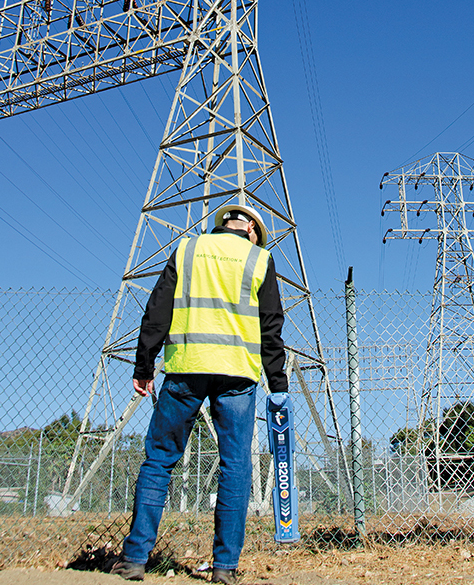
Radiodetection locators are built for complex utility environments where signal clarity, interference rejection, and depth accuracy matter most. Their premium offerings, like the RD8200 precision locator, add features such as a gyroscopic swing‑warning system, vibration alerts, self‑test functions, and usage‑logging with GPS. Paired with RDMap™+ and high‑accuracy GNSS, operators can create cm‑accurate maps while they locate. Dual Bluetooth connectivity and custom frequencies mean the locator integrates with mobile devices and cloud‑based software.
Core strengths:
• Active & passive EM locating with programmable frequencies.
• Strong performance in congested corridors thanks to advanced signal processing and current‑direction modes.
• Data logging & cloud connectivity through Locate Performance Management, offering site reports, risk indicators, instant alerts, and GIS integration.
• Self‑test and swing‑warning safety features that help operators stay perpendicular and avoid missed warnings.
Radiodetection equipment is commonly selected when:
• Utilities run parallel or overlap, and interference is present from nearby lines.
• Documentation accuracy, as‑built mapping, and regulatory compliance are critical.
• Crews want to log locates with GPS and share data via ArcGIS or other GIS platforms.
Best fit for:
• Utility contractors working in dense urban corridors.
• Engineering & survey firms needing cm‑accurate geospatial data.
• Municipal infrastructure teams seeking data‑driven asset management.
• Damage‑prevention driven operations looking to reduce utility strikes.
Fisher: Practical EM & Magnetic Solutions
Fisher locators are known for simplicity, reliability, and value. They offer both electromagnetic and magnetic locating options that are easy to deploy without a steep learning curve. Their rugged receivers and transmitters use sealed injection‑molded housings and IP65 weatherproof ratings. Models like the TW‑82 provide one‑button operation, while the TW‑82P and TW‑8800 add passive power modes and multi‑frequency capability (820 Hz, 8.2 kHz, and 82 kHz). These devices deliver long battery life (80–130 hours on a pair of D‑cells for the TW‑82) and remain dependable in harsh field conditions.
Core strengths:
• Straightforward operation with intuitive audio/visual left‑right guidance and automatic gain control.
• Durable field‑ready designs with IP65 ingress protection and impact resistance.
• Strong performance for routine locating where utilities are metallic, and conditions are consistent.
• Excellent cost‑to‑performance ratio, especially in multi‑frequency TW‑8800 models that combine active and passive modes.
Fisher equipment is often chosen when:
• Crews need dependable daily‑use tools for tracing conductive pipes and cables.
• Training time must be minimal; operators can be proficient quickly.
• Projects involve consistent, known utilities rather than congested cross‑country corridors.
• Agencies value ruggedness and long battery life over advanced digital features.
Best fit for:
• Public works departments.
• Maintenance crews.
• Contractors handling predictable utility layouts.
Schonstedt: Precision Magnetic and Multi‑Frequency Locating
Schonstedt specializes in magnetic detection, making it the industry standard for locating ferrous underground objects such as valve boxes, manholes, and corner markers. However, Schonstedt also offers portable electromagnetic locators, u‑LOCATE and Rex, that deliver multi‑frequency capability and portability.
Core strengths:
• Highly sensitive magnetic sensors for pinpointing iron and steel targets with no signal coupling required.
• Rugged, ergonomic EM locators like u‑LOCATE, featuring a high‑contrast screen, headphone socket, and shock‑resistant casing.
• Multi‑frequency versatility in Rex, which operates at 512 Hz, 33 kH,z and 82 kHz with passive and sonde modes; the combined receiver and transmitter weigh under 7 lb.
• Portability: u‑LOCATE weighs about 2.4 lb and offers up to 20 hours of use on six AA batteries, while Rex uses a rechargeable NiMH pack and retracts for easy carrying.
Schonstedt magnetic locators excel when:
• Locating valves, manholes, vaults, caps, and markers where EM locating is ineffective.
• Working in electrically noisy environments where interference hampers EM detectors.
• Precision pinpointing is required without needing to inject signals.
With u‑LOCATE and Rex, Schonstedt also competes in the EM space:
• u‑LOCATE: A single‑frequency (82 kHz) or dual‑frequency (33/82 kHz) avoidance tool with 512 Hz sonde capability. It includes left/right arrows, audio guidance, and depth estimation at the press of a button, plus weatherproof IP65/NEMA 3S protection.
• Rex: An ultralight multi‑frequency locator offering 5 W of transmitter power and a three‑year warranty. Its retractable receiver and slim transmitter make it easy to carry in the field.
Best fit for:
• Utility maintenance teams and water/sewer departments needing precision ferrous detection.
• Surveyors locating buried iron assets.
• Contractors who value portability and need both magnetic and multi‑frequency EM locating capabilities.
Side‑by‑Side Utility Locator Comparison
Accuracy, Depth & Interference: What Actually Matters
Depth readings and accuracy are highly dependent on:
• Soil conditions (conductive soils may attenuate high frequencies).
• Utility material (copper vs iron vs plastic with tracer wire).
• Signal strength and coupling method.
• Operator technique: proper orientation is critical, which is why the RD8200 includes a swing‑warning system and vibration feedback.
Radiodetection’s advantage lies in signal clarity, interference rejection, and the ability to log locates with GPS and create as‑built maps. Fisher offers dependable performance where environments are consistent and ruggedness matters. Schonstedt bypasses electrical interference entirely by detecting magnetic signatures or by offering multi‑frequency EM tools with IP65 weatherproof designs. This is why many professional crews carry both EM and magnetic locators: one to trace energized utilities and the other to find ferrous objects.
Why Eastcom Support Changes the Buying Equation
Most locator issues aren’t hardware failures. They’re application mismatches. Eastcom Associates doesn’t just sell equipment.
We provide:
• Hands‑on product demonstrations: See how GPS logging, mapping, and swing‑warning features perform on your job site.
• Application‑based recommendations: Match frequency options (8.2 kHz vs 33 kHz) to soil conditions and utility types.
• Operator training & onboarding: Learn to interpret depth readings and avoid interference.
• Ongoing technical support: Troubleshoot battery life, firmware update,s and accessory selection.
• Long‑term service relationships: Extend warranties and keep your fleet ready. That support ensures your locator is:
• Properly configured.
• Used correctly from day one.
• Matched to your actual job conditions.
How to Choose the Right Locator (Fast Decision Framework)
Choose Radiodetection if:
• You work in congested utility corridors where interference is high.
• Accuracy, mapping, and data logging are top priorities; you require GPS tagging, cloud integration, or custom frequencies.
• You want features like swing‑warning alerts, self‑test, and vibration feedback to improve operator technique and safety.
Choose Fisher if:
• You need reliable, easy‑to‑use equipment for daily locating with minimal training.
• Multiple crews require consistent results quickly and value a rugged IP65 housing with long battery life.
• Your projects involve consistent, known utility layouts, and you don’t need advanced data logging or mapping.
Choose Schonstedt if:
• You frequently locate valves, caps, and ferrous infrastructure where magnetic detection is unbeatable.
• Portability and multi‑frequency versatility are important; you appreciate an ultralight locator with 512 Hz, 33 kHz, and 82 kHz options and up to a 3‑year warranty.
• Precision pinpointing is required, and you may carry both magnetic and EM tools to cover every scenario.
Still Unsure? Request a Utility Locator Demo
The fastest way to choose the right locator is to see it work in your environment. Eastcom Associates offers live demonstrations of Radiodetection, Fisher, and Schonstedt equipment so you can evaluate:
• Signal clarity and interference rejection.
• Ease of use for crews with different experience levels.
• Accuracy and depth readings on your job sites.